Table of Contents
- Quick Answer: AI SDR vs Human SDR in 2026
- The 2026 Outbound Landscape: Automation Hype vs Reality
- Key Benchmark Metrics: What the Numbers Actually Say
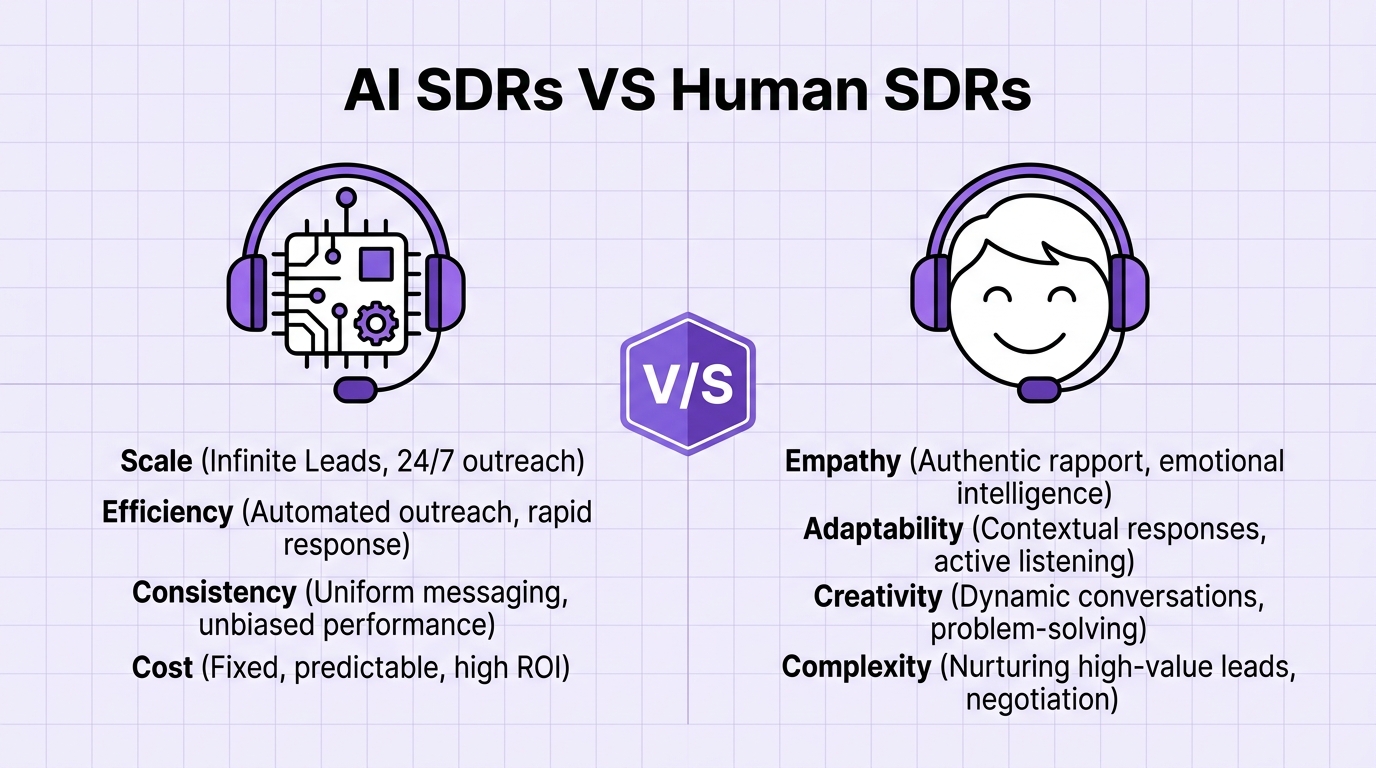
- AI SDR vs Human SDR Comparison Matrix
- The True Cost Comparison: In-House SDR Economics vs AI Tool Pricing
- When Should You Use AI SDRs? (The High-Volume Playbook)
- When Should You Use Human SDRs? (Enterprise & High-ACV Pipeline)
- Can AI SDRs Handle Live Cold Call Objections? (Spoiler: No)
- The Winning Architecture: The Blended Hybrid SDR Model
- Outsourced SDR vs In-House SDR vs AI: Making the Right Call
- The Outbound Topic Cluster & Resource Hub
- Key Takeaways & Practitioner Summary
- How We Help: A Mix of AI Tools and Real Callers
- Frequently Asked Questions (FAQ)
Quick Answer: AI SDR vs Human SDR in 2026
The Quick Answer: An AI SDR is great at high-volume email scraping, automated list enrichment, and low-cost initial touches ($400 - $1,500/month), but response rates on cold email have plummeted below 0.5% and bots cannot handle live cold call objections. A Human SDR costs way more ($75,000 - $95,000/year fully loaded), but delivers 6x to 10x higher meeting conversion on high-ticket deals ($20k+ ACV) because real people can build rapport, navigate gatekeepers, and pivot during unexpected objections. In 2026, the smartest revenue teams run a hybrid SDR model: using AI for backend data scraping and domain warmup, while experienced human SDRs pick up the phone to book qualified demos directly on your calender.
The 2026 Outbound Landscape: Automation Hype vs Reality
I'll be honest: back in early 2024, when autonomous AI sales agents first started flooding my LinkedIn feed, I thought they might kill my job.
I was wrong, mostly.
We actually spent three weeks testing an automated voice bot pipeline hooked up to Twilio and ElevenLabs on cold leads. The result? Zero qualified meetings. The moment a prospect answered with "Hey, who is this?", the 450ms audio latency kicked in, the bot stuttered on the prospect's company name, and the buyer immediately said: "Look, if you're a robot just hang up." And they clicked off.
Look around today: the outbound game has shifted dramatically.
- Inboxes block almost everything: Stricter spam filters from Google and Yahoo mean mass-blasting generic AI templates will burn your secondary domain reputation in under two weeks.
- You can just tell it's a bot: Buyers get 30 automated emails a day starting with "Hope you're having a productive Tuesday, saw you lead sales at [Company]..." They delete them without opening.
- The phone is where real deals start: Because digital inboxes are polluted with AI spam, decision-makers are actually answering their direct mobile lines - if you speak to them like a respected peer rather than a scripted machine.
Key Benchmark Metrics: What the Numbers Actually Say
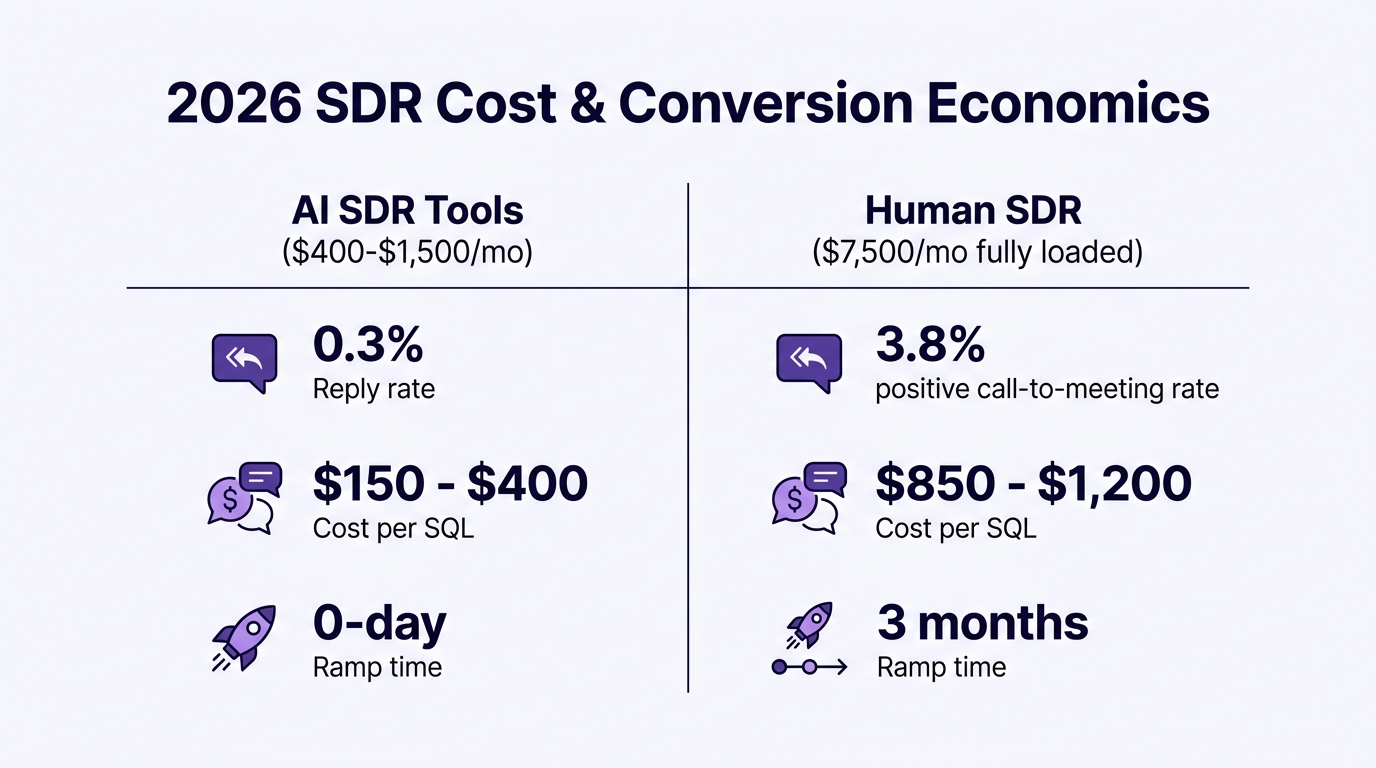
Let's cut through the vendor marketing and look at realistic performance metrics based on industry benchmarks (from The Bridge Group SDR reports and SaaStr outbound surveys) alongside my own data across 57,000+ cold dials:
📊 2026 Outbound Performance Benchmarks
Positive Email Response Rate: AI Cold Email Blasts: 0.2% - 0.5% | Highly Researched Human Outbound: 1.8% - 3.2%* (SaaStr outbound survey data)
Cold Call Connect-to-Meeting Rate: AI Voice Bots: < 0.4% | Skilled Human Caller: 3.5% - 5.8%* (Across my production dial blocks)
SDR Meetings Booked Per Month: AI SDR Tools: 3 - 6 (mostly tire-kickers and low-intent clicks) | Dedicated Human SDR: 8 - 15 (vetted decision-makers)*
Cost Per Qualified Meeting: AI SDR Tooling: $150 - $350 | Human SDR Outbound: $450 - $850* (In my experience running client campaigns, this lands closer to $500 - $800 once you factor in no-shows)
Average Ramp Time: AI Software Setup: 2 - 5 days | In-House Human SDR: 90 - 120 days*
Annual SDR Turnover: AI Software: 0% | In-House SDR Reps: 34% - 42%* (According to Bridge Group industry averages)
Best Suited Deal Size (ACV): AI SDR: <$4,000 ACV | Human SDR: $15,000 - $200,000+ ACV*
AI SDR vs Human SDR Comparison Matrix
Here is how both approaches stack up when you evaluate real operational day-to-day work:
| Evaluation Dimension | Autonomous AI SDR | Human SDR (In-House) | Blended Hybrid SDR Model |
|---|---|---|---|
| Primary Channels | Automated cold email, LinkedIn connect requests | Multi-channel: Cold calling, custom video, LinkedIn | AI email & data scraping + Human phone dialing |
| Fully Loaded Cost | $4,800 - $18,000 / year | $75,000 - $105,000 / year | $30,000 - $48,000 / year (agency or hybrid) |
| Ramp Time | Instant (2 - 5 days) | 3 - 4 months of coaching & ramp | 1 - 2 weeks to dial live |
| Daily Activity Volume | 500 - 2,000 automated emails/day | 80 - 120 targeted cold dials + 25 custom emails | 400 warmed emails (AI) + 100 cold dials (Human) |
| Live Objection Handling | Fragile decision trees (breaks easily) | Dynamic, empathetic, context-aware | Proven practitioner objection battlecards |
| Meeting Show-Up Rate | 45% - 60% (lots of ghosting) | 80% - 90% | 85% - 92% |
| Domain Reputation Risk | High (frequent burner domains needed) | Very Low (human-paced deliverability) | Managed deliverability with warmup safeguards |
| Enterprise Account Fit | Poor (treats enterprise accounts like generic leads) | Excellent (maps buying committees & champions) | AI scrapes org charts; humans work stakeholders |
| Pipeline Quality | Low-ticket, transactional | High-ticket Mid-Market & Enterprise | Maximum qualified pipeline velocity |
The True Cost Comparison: In-House SDR Economics vs AI Tool Pricing
When founders compare the cost of a human SDR against AI SDR pricing, they almost always compare a $1,000/month software invoice to a $55,000 base salary. That math is completely misleading.
1. What an In-House Human SDR Actually Costs
Hiring an in-house SDR in North America or Western Europe comes with heavy hidden overhead:
- Base Salary: $50,000 - $65,000
- OTE Commission: $20,000 - $30,000
- Taxes & Healthcare Benefits: $12,000 - $16,000
- Tech Stack per Seat: (LinkedIn Sales Nav, ZoomInfo/Apollo, Power Dialer, CRM): $8,000 - $12,000/year
- Management Overhead: 15 - 20 hours a month of sales leadership coaching
- The Churn Tax: When an SDR quits after 9 months (which happens constantly across tech teams), you lose $8,000+ in recruiting and 3 months of lost pipeline while you start over.
Real Fully Loaded Cost: $90,000 - $115,000+ per year.
2. What AI SDR Software Actually Costs
If you buy an autonomous AI SDR tool or outbound platform, your costs look like this:
- Base Tool Subscription: $400 - $1,200/month
- Data Credits & Waterfall Enrichment (Clay, Prospeo, Apollo): $200 - $500/month
- Domain Infrastructure & Mailbox Warmup: (10 - 20 secondary Google/Outlook mailboxes): $100 - $250/month
Total Annual AI Tool Cost: $8,500 - $22,000/year.
My Take on the ROI: If you sell a $50/month SaaS tool, an AI SDR is a no-brainer. But if your average deal size is $25,000, you only need one or two extra closed deals per year from a skilled human caller to completely wipe out the salary difference and generate massive ROI.
When Should You Use AI SDRs? (The High-Volume Playbook)
I am not anti-AI. When used for the right business model, automated outbound tools can be incredible leverage.
Go AI-Only When:
- Your Deal Size is Small (<$3,000 ACV): You simply cannot afford an $85k rep to sell a $150/month subscription. The unit economics will never work.
- You Have a Massive TAM (100,000+ potential buyers): If your market is huge, getting a 0.3% reply rate still produces a steady trickle of demo requests without exhausting your addressable accounts.
- Inbound Speed-to-Lead: Having an AI tool scrape an inbound demo lead's tech stack and draft an immediate response in 45 seconds is brilliant.
- Early Messaging Experiments: Testing 8 different value propositions across 1,000 accounts each to see which pain points get opened.
When Should You Use Human SDRs? (Enterprise & High-ACV Pipeline)
Here is where automated AI bots will fall flat on their face every single time.
You Defenitely Need Real Human SDRs When:
- Your Deal Size is High ($20,000 - $150,000+ ACV): When closing three deals can make your entire quarter, you cannot afford to have a robotic email blast burn your relationship with a target CTO.
- You Have a Small, Named Account List (ABM): If you only have 500 target accounts in your entire market, sending generic automated copy to all of them is marketing suicide.
- You Need to Navigate Gatekeepers & Multi-Thread: AI bots cannot talk to an executive assistant, ask who manages data infrastructure, and get transferred to the VP's direct extension.
- Offline & Phone-Heavy Industries: If you sell to construction general contractors, logistics dispatchers, manufacturing plant managers, or commercial HVAC owners, they don't sit at a desk reading cold emails. You have to call them.
Can AI SDRs Handle Live Cold Call Objections? (Spoiler: No)
The founders trying to sell you "fully autonomous AI cold calling reps" are selling shovelware.
I've tested these voice bots on live prospect numbers. Every single one got hung up on inside 20 seconds.
Here is why live phone calling is still strictly human territory:
- The Unforgiving Latency Gap: When a busy executive picks up and says "Yeah, who's this?", even a 400-millisecond delay while the AI streams tokens makes the prospect realize it's a bot. They hang up immediately.
- Objection Nuance: When an executive yells, "Where did you get my cell phone number?!", an AI bot panics or recites a robotic legal disclaimer. A human caller takes a calm 1-second pause, lowers vocal pitch, and disarms them: "Fair question, John - our research team pulled your direct line from ZoomInfo because you run engineering at Acme..."
- Active Listening: A prospect might sigh, mention they're walking into a board meeting, or casually drop their current software renewal date. A human picks up on that gold immediately; an AI bot just pushes to line two of its prompt.
If you want to see how top reps actually handle pushback, read our guide on Proven B2B Cold Calling Techniques That Consistently Book Executive Meetings or our playbook on Top 5 Cold Call Objection Handling Techniques for B2B Reps.
The Winning Architecture: The Blended Hybrid SDR Model
The future of high-converting B2B outbound isn't replacing humans with software - it's giving human callers superhuman leverage using AI.
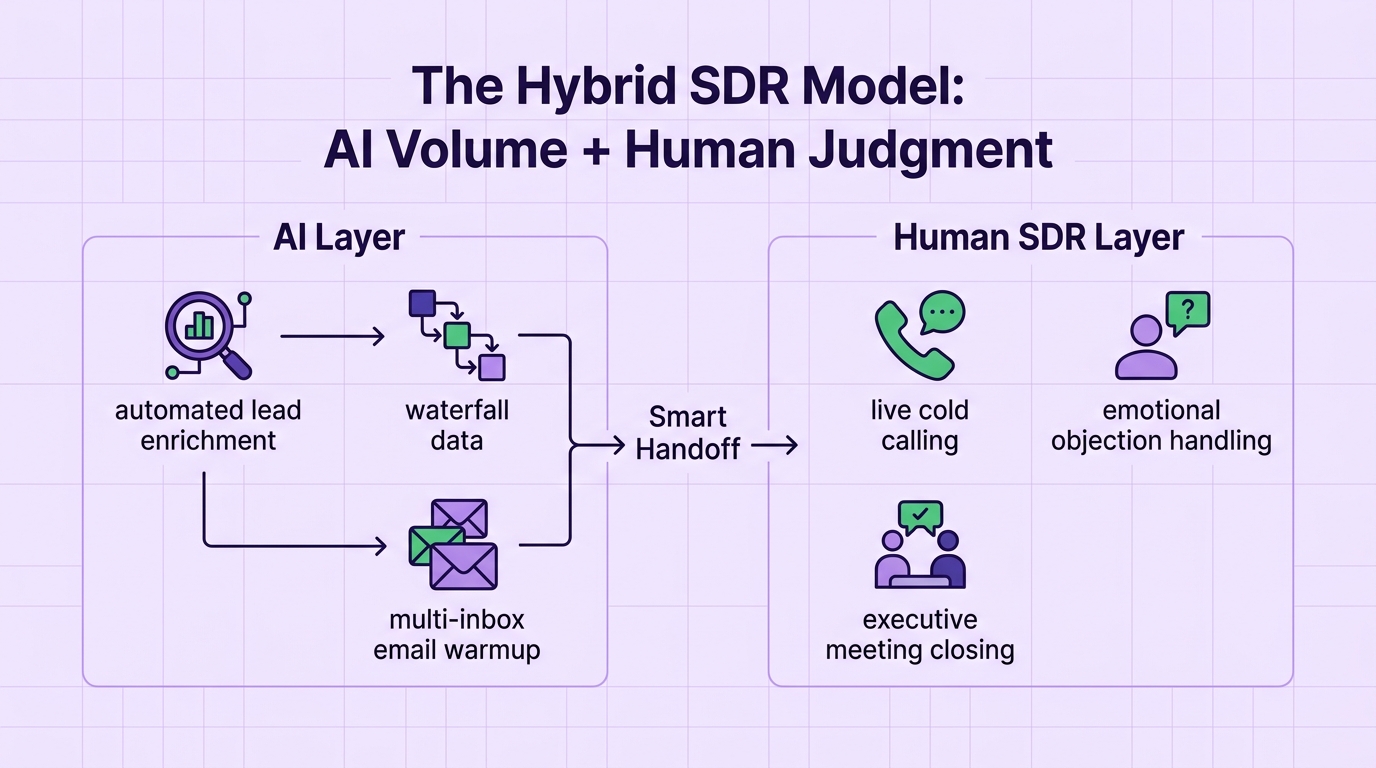
Here is the exact framework we use to generate predictable pipeline:
1. The AI Automation Layer (Scale & Data)
- Waterfall Data Enrichment: Using Clay and scrapers to pull mobile numbers from Apollo, ZoomInfo, and LinkedIn in seconds.
- Trigger Signals: Automatically flagging when an account hires a new VP or raises funding.
- Secondary Inbox Warmup: Keeping 15+ seperate mailboxes warmed up with flawless SPF, DKIM, and DMARC health so emails never hit the spam folder.
2. The Human Execution Layer (Conversations & Closing)
- High-Impact Cold Calling: Seasoned callers dialing verified direct mobile numbers with conversational, permission-based hooks.
- Live Discovery: Asking open-ended questions to uncover what software the company is actually unhappy with.
- Executive Booking: Locking in firm calender invites directly with qualified decision-makers who actually show up.
Outsourced SDR vs In-House SDR vs AI: Making the Right Call
If you're deciding how to allocate your outbound budget this quarter, here is the honest breakdown:
- AI Software Stack ($1,000 - $1,800/mo): Perfect if you're a bootstrapper selling a low-cost product with plenty of time to tinker with prompts and webhooks.
- In-House SDR Team ($8,000 - $10,000/mo per rep): Best if you already have a proven sales playbook, full-time sales management, and the budget to absorb 3-month ramp times and rep churn.
- Blended Outbound Partner ($3,000 - $5,000/mo): The highest-ROI option for scaling B2B companies. You get full enterprise data infrastructure and an experienced human caller booking meetings, without the payroll taxes or management headache.
For a full breakdown of the math, check out our deep dive on Outsourced BDR vs. In-House Appointment Setting: A Startup Cost-Benefit Analysis.
The Outbound Topic Cluster & Resource Hub
Check out our other deep dives on building a modern outbound engine:
- [Outsourced BDR vs In-House Cost-Benefit Analysis](/blog/outsourced-bdr-vs-inhouse-appointment-setting): Line-by-line financial comparison of building vs outsourcing your SDR function.
- [How B2B Cold Calling Actually Works in 2026](/blog/how-b2b-cold-calling-actually-works-2026): Scriptless discovery techniques for modern executive buyers.
- [Cold Calling vs Cold Email: Channel Comparison](/blog/cold-calling-vs-cold-email-b2b-lead-generation): Connect rates, response metrics, and hybrid cadences.
- [Email Deliverability & Domain Warmup Masterclass](/blog/warm-up-new-sales-email-domain): How to protect domain reputation and avoid spam filters.
- [How to Handle 'Where Did You Get My Number?' on Cold Calls](/blog/how-to-answer-where-did-you-get-my-number-cold-call-objection): 3 compliance-safe live objection scripts.
Key Takeaways & Practitioner Summary
- AI SDRs win on volume and data processing: Great for low-ACV SaaS and running automated list building in the background.
- Human SDRs win on high-ticket pipeline: Crucial for $20k+ deals where phone discovery, rapport, and emotional nuance make or break the deal.
- The hybrid model beats both: Using AI to do the tedious data scraping while human callers handle live conversations produces the lowest cost per closed-won customer.
- Don't fall for voice bot hype: Real B2B decision-makers hang up on automated AI callers within 15 seconds. Keep your live dials human.
How We Help: A Mix of AI Tools and Real Callers
Building an outbound engine from scratch is painful. Most founders spend six months buying expensive software licenses, hiring the wrong reps, and burning their domain reputation.
At Willay Haider Outbound Systems, we do the heavy lifting for you:
- 57,000+ Cold Dials Logged: Real practitioner dialing, not robotic voice scripts.
- $2.5M+ Pipeline Generated: Qualified executive meetings delivered directly to your calendar.
- Full Data & Tech Stack Included: Waterfall mobile enrichment, verified lists, custom objection battlecards, and clean CRM sync.
Take a look at our Outbound Services, check out our Case Studies, review our Pricing, or Book a Strategy Call to discuss building your outbound pipeline.
Frequently Asked Questions (FAQ)
Will AI SDRs replace human SDRs?
AI SDRs will replace low-skill tasks like lead scraping, list cleaning, and basic email blasts. However, they will not replace human SDRs for high-ACV deals requiring live phone discovery, emotional nuance, complex gatekeeper navigation, and dynamic real-time objection handling.
Is an AI SDR cheaper than a human SDR?
Yes, software subscriptions for an AI SDR typically run $400 to $1,500 per month, compared to $75,000 to $95,000 annually for a fully loaded in-house rep. However, on deals over $20,000 ACV, human callers produce far higher closed-won revenue.
Can an AI SDR handle live cold call objections?
Currently, AI voice bots fail on live cold calls due to API audio latency (350ms - 500ms) and an inability to understand emotional context. When prospects push back with skepticism or privacy objections, bots trigger unnatural loops that irritate buyers and burn domain credibility.
What does a blended hybrid SDR service cost?
A managed blended SDR service typically costs between $3,000 and $5,000 per month. This provides full AI data enrichment, verified mobile lists, multi-inbox domain warmup, and experienced human sales reps executing live cold calls without internal hiring overhead.
How many meetings per month does an AI SDR book compared to a human SDR?
An AI SDR tool typically books 3 to 6 meetings per month from mass cold email, though lead qualification and show-up rates tend to be lower. A dedicated human SDR conducting targeted multi-channel cold calling typically books 8 to 15 highly qualified executive meetings per month.